


Family-friendly University of Stuttgart
The University of Stuttgart has been recognized several times over the years for being family-friendly. It is dedicated to the continued development of a support offerings it currently provides for employees and students by way of family-friendly work and study environments. It is not only members of the University with family obligations who benefit from a university that is organized as family-friendly: we also win by attracting and retaining highly qualified employees, using our human resources more effectively, and reducing family-conditioned interruptions to studies.
All University of Stuttgart members have a responsibility for implementing these goals and standards, but this applies especially to management. Our university leadership lends its active support to making career and studies compatible with family life.
"Part of our strategy is the balance between career, studies and family for our university's members."
Prof. Wolfram Ressel, Rector, University of Stuttgart
As family, the University of Stuttgart understands all life partnerships which take on long-term social responsibility, including parents and children, life partners, siblings, grandparents, as well as relatives needing care.

Information for employees and students
Under the Career & Family (only available in German) tab on the University of Stuttgart’s website, employees with children or relatives requiring care can find information on the following topics:
- Paid maternity leave
- Parental leave
- Caregiving leave
- Flextime options
- Telecommuting
- Childcare
- Infrastructure and interchange
Students with children or who are caregiver relatives find tailor-made information on the website under the tab Studies & Family:
- Paid maternity leave
- Flexible study options
- Childcare
- Financial help
- Infrastructure and interchange
"The university, as an employer, supports all of its employees in living up to their individual potential. It champions the work-life balance and is committed to equality.”
University of Stuttgart's mission statement
Childcare
For its employees, the University of Stuttgart offers regular childcare in cooperating daycare facilities near Campus Vaihingen and Campus City Center. The available spots are open to young children aged 2 months to 3 years and are independent of the employee's residential address. In addition, the University of Stuttgart is a member of Kind e. V. Stuttgart, so that employees with children up to the age of 14 have access to the daycare facilities of the provider “Kinder in Stuttgart GmbH“ near the Campus Vaihingen.
For details, please visit the Job & Family web page
Studierendenwerk Stuttgart (Stuttgart student union) and Stups e.V. offer places for full-time childcare for students and doctoral researchers in their own daycare facilities in Stuttgart, Esslingen and Ludwigsburg, preferably for children aged 6 months to 3 years and aged 3 to 6 years.
For details, please visit the Studies & Family web page
Flexible childcare at the University of Stuttgart includes:
- Emergency childcare in daycare facilities and at home in the event that regular childcare has been canceled at short notice (available for employees and students)
- Childcare during events, further training and recruitment procedures (available for institute employees)
- Providing flexible childcare for other purposes (available for employees, doctoral researchers and students at their own expense)
At a glance:
Emergency childcare is a free offer by the University of Stuttgart for its employees and students on two days per semester if regular childcare has been canceled at short notice. It usually takes place in daycare facilities. Exceptions, i.e. additional childcare or the use of emergency childcare at home (for example in case of illness of the child or evening events), are possible in case of compulsory events or urgent, official interest.
Generally, institutions of the University of Stuttgart can book flexible childcare during events, further training and recruitment procedures at their own expense via the cooperation agreement. There is an annual quota for events relating to the university as a whole.
The provision of flexible childcare for other purposes at one's own expense is an additional service in cases where the immediate reconciliation of work, university studies and family life is not the key issue.
The Uni & Family Service organizes the Stuttgart “research holidays” for children of students, doctoral researchers and staff at the University of Stuttgart together with the Konzept-e gGmbH, the five Fraunhofer institutes in Stuttgart and the Hochschule der Medien. The research holidays are held for one week in the Easter, Pentecost and autumn holidays as well as for three weeks in the summer, making sure that your children’s creativity does not go to waste over the school holidays and that they are challenged in a way which is exciting. It is open to children from 6 to 12 years old (including siblings from age 4).
During many school holidays, the university sports center, too, offers holiday weeks for children and young people aged between 8 and 15 and whose parents are students or staff.
For children from 0 to 6 years old, we offer a childcare service during school holidays in one of the facilities belonging to our long-term cooperation partner “Himpelchen und Pimpelchen“.
For details, please visit the Job & Family and Studies & Family web pages.
In addition to the above-mentioned service exclusively for employees, doctoral researchers and students of the University of Stuttgart, there are other municipal, church-based and free providers of daycare facilities in Stuttgart and the surrounding area, as well as the option of daycare in families. Also, emergency childcare and daycare during holidays can be used outside the university facilities.
For details, please visit the Job & Family and Studies & Family web pages.
Map: FamiliesCAMPUS
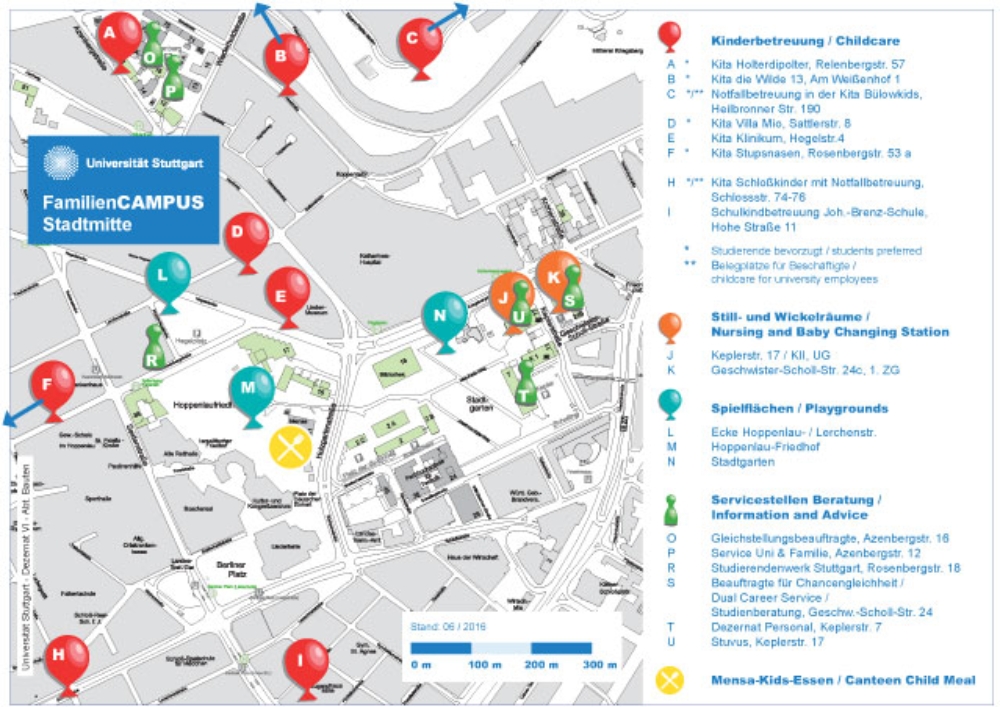
The maps „FamiliesCAMPUS Stadtmitte“ and „FamiliesCAMPUS Vaihingen“ show all family-related locations of our university: childcare, diapering facilities, playgrounds and service points for families.
Infrastructure and service offerings
We believe that a family-friendly infrastructure at both our university locations matters: therefore, we set up functional breastfeeding and diapering facilities in key locations and plan to make them standard in new and remodeled buildings.
Parent-child areas are being developed in two multifunction rooms in the House of Students and ARENA2036 on the Vaihingen Campus and in work rooms in the two University Library locations. In addition, Stuttgart Student Services makes family apartments available to students with children.
The Uni & Family Service in the Gender Equality Office is the go-to resource for all staff members and students with questions on balancing career, studies, and family at the University of Stuttgart. The Uni & Family Officer coordinates already existing and develops further compatibility measures and supports the university's internal networks. In addition, she has project responsibility for the "audit familiengerechte hochschule" (family-friendly university audit) and represents the university management in regional and national networks, especially in the largest German-speaking network for family policy at universities, the "Familie in der Hochschule e.V.".
The University of Stuttgart has appointed an interested employee as a care advisor. The care advisor offers a personal point of contact for employees and students who care for relatives. The advisor provides assistance if, for example, a relative suddenly requires care unexpectedly, as well providing information about where affected persons can obtain further advice.
More information about the topic of caring for relatives can be found at Career & Family [german] for employees and Studying & Family for students.
Interchanges between members of the University community are encouraged at the University of Stuttgart. There are currently four variously active FamilyNETWORKS whose members mostly meet over lunch to swap information and views:
- Research & Family
- Management & Family
- Studies & Family
- Uni & Caregiving
- Virtual FamilyNETWORK with
- Virtuelles FamilienNETZWERK
For details, please see the Job & Family and Studies & Family web pages.
The University of Stuttgart every semester offers its employees a rich continuing education program. Under the topic heading “audit Family-friendly University” specifically you will find seminars that support employees in reconciling career and family, with special emphasis on caregiving.
Issues of concern to dual career couples occupies a special place in negotiating appointments to the University of Stuttgart. Highly qualified academics and their equally ambitious partners are offered support for their careers with individualized services under the Dual Career Program. The Dual Career team is part of the Staff Development section in the Personnel Division.
Hohenheim-Stuttgart Kids University
The Kids University is offered by the University to children between the ages of eight and twelve. Every semester, professors explain complex sets of facts relating to topics in their research fields in terms children can understand.
Pupil Campus on Science Day
Once a year, the University of Stuttgart opens its laboratories for Science Day to let visitors explore the world of science and its insights. The day includes a Pupil Campus, a program of exploration geared to children and youth when not just observing and listening but doing hands-on experiments frequently is the order of the day.
Mensa: Kids eat free
Students‘ children up to the age of ten can partake of meals free of charge in Stuttgart Student Services cafeterias.



Family-friendly certified
The University of Stuttgart has been certified as a "family-friendly university" since 2012, and this status was renewed in 2015 and 2018. Since 2022, the University of Stuttgart has been permitted unlimited use of the "family-friendly university" certificate logo. The certificate is a Europe-wide seal of approval for family-friendly studying conditions and a family-conscious employment policy.
The University of Stuttgart is a member of the business network "Success Factor Family" and supports the Family Policy Commission at the "The Federal Conference of Women's and Equal Opportunity Commissioners at Universities (bukof)". The University of Stuttgart is a founding university of the "Family in Higher Education" network and has signed the "Family in Higher Education" charter.
The university's membership in the associations "Kinderfreundliches Stuttgart e. V." and "Kind e. V. Stuttgart" is a clear sign of its committment in this area. We work closely with universities in the region on reconcilability issues and implement joint projects.
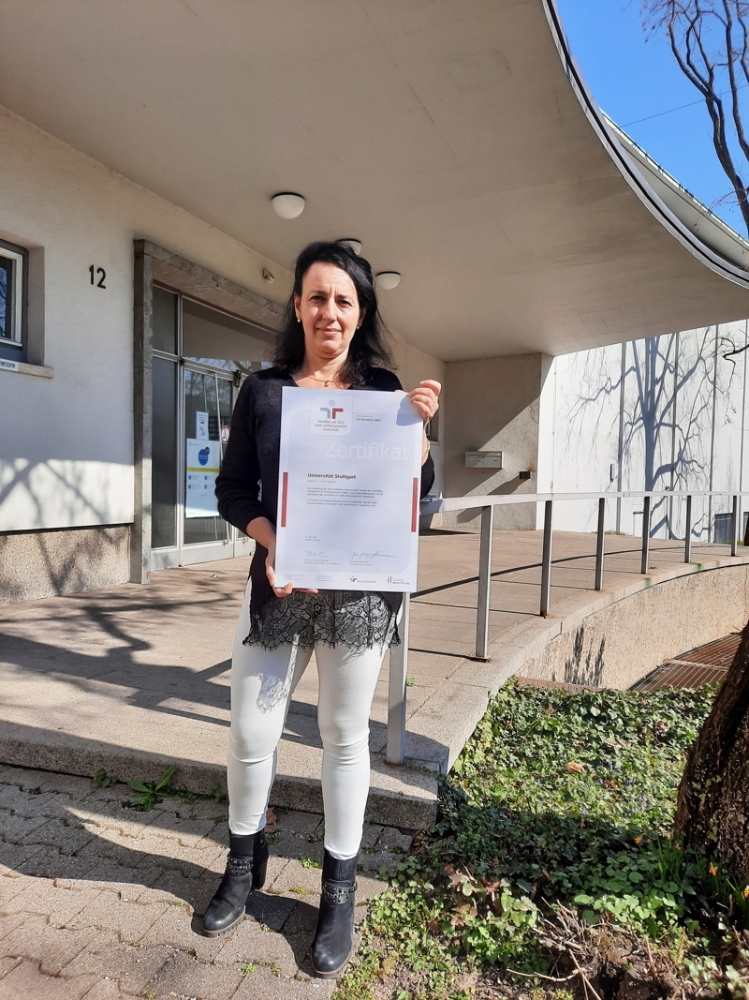
Contact

Inken de Wit
Service Uni & Family
- Profile page
- +49 711 685 84037
- Write e-mail
- Monday - Friday: 9 a.m. to 12 p.m.

Julia König
B.A.Service Uni & Family
- Profile page
- +49 711 685 84037
- Write e-mail
- Tuesday to Thursday: 9 a.m. to 3 p.m.